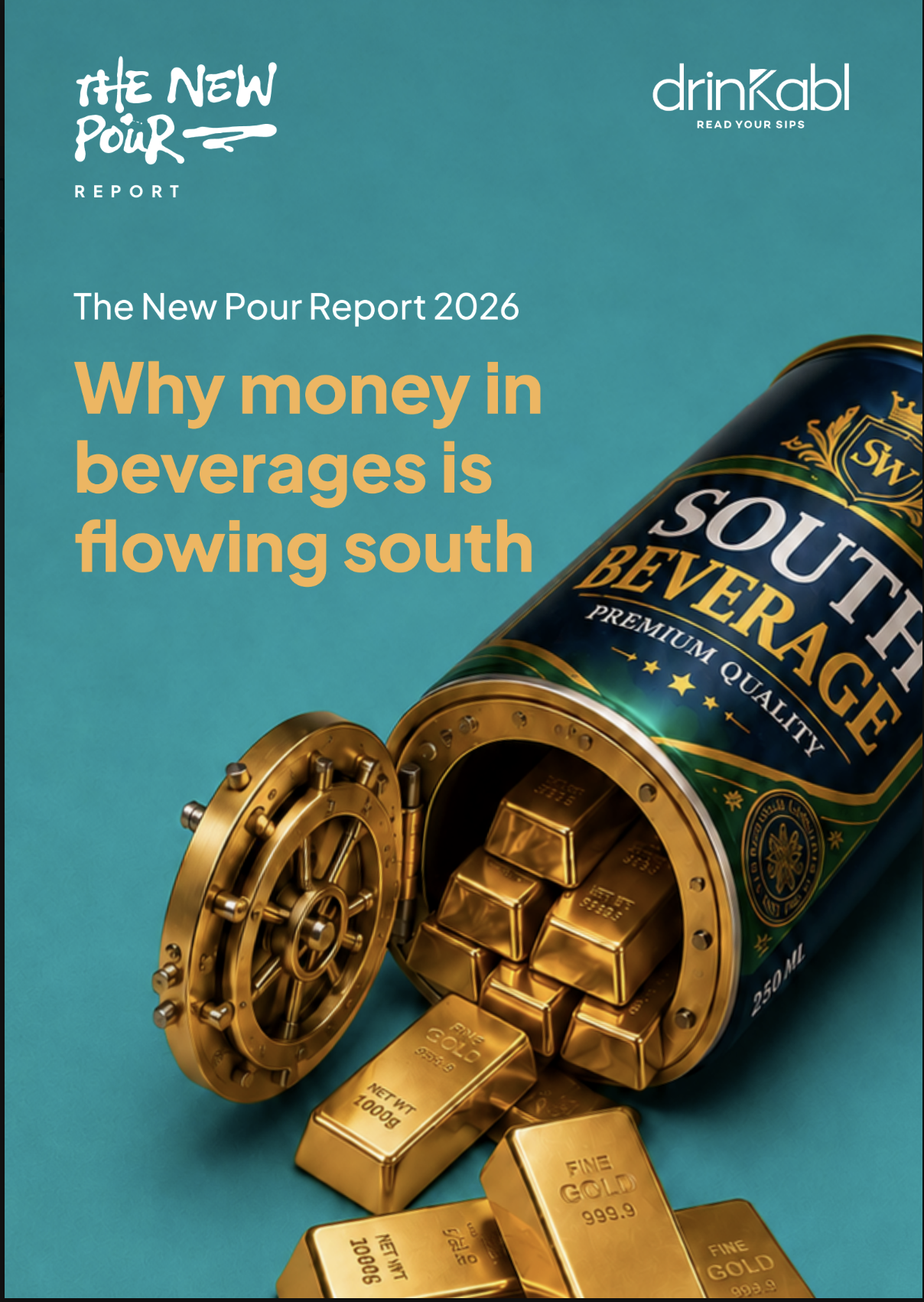
Africa is not following the world's drinking trends. It is creating them.
Why money in beverages is flowing south. A data-led look at the most significant geographic reorientation in the global beverage industry's history.
Scroll to begin
Why We Made This Report
About This Report
Built from 15+ sources, 6 expert points of view, and conversations from the New Pour Summit press conference.
Cross-referenced against Drinkabl Africa's ongoing editorial coverage, spanning alcoholic and non-alcoholic beverage markets across Sub-Saharan and North Africa: Nigeria, South Africa, Kenya, Ghana, Ethiopia, and Egypt.
15+
Independent data sources
6
Expert points of view
5+
In-depth interviews
Part One · The Big Picture
$130.8B
Africa's alcoholic drinks market by 2029, growing at a 7.35% CAGR, nearly double the pace of the US.
Urbanising faster than any continent, with a middle class expanding in real time, Africa has stopped following global drinking trends. It is writing its own.
The New Pour Report 2026
$130.8B
Africa's alcoholic drinks market by 2029, at a 7.35% CAGR. Nearly double the US growth rate.
Drinkabl Africadrinkabl.media
Why Here, Why Now
Two markets, two trajectories.
While the Global North contracts, Africa accelerates. Illustrative index anchored to reported growth and decline figures, 2019 to 2029.
-3.7%
US spirits depletions, 2024
-27.8%
Diageo operating profit, FY2025
-7.2%
US wine volume decline, 2024
-12%
Global alcohol consumption, 2010 to 2022
Index is illustrative, anchored to reported CAGR and decline figures (IWSR, Statista, Food Ingredients First, The Drinks Business), not a precise sub-series.
The Prize
Coffee, tea, wine, and alcohol, read against one theme: a large prize, real friction, proven resilience.
$130.8B
Africa alcoholic drinks market by 2029
$124B
Non-alcoholic beverage revenue, 2025
$46.75B
Beer, Africa's number one alcohol category
$3B
Ethiopia coffee exports, record 2025/26
$1.44B
Kenya tea earnings, volumes up about 10%
1.37M T
South Africa wine harvest 2026, rebounding to premium
Global Capital Is Backing Africa
$4.9B has already moved. Global capital is not waiting.
Coca-Cola HBC, $2.6B
Acquires a 75% stake in Coca-Cola Beverages Africa, entering 14 markets including Ethiopia, Kenya, and South Africa in one transaction.
Asahi Group, $2.3B
Buys Diageo's 65% stake in East African Breweries across Kenya, Uganda and Tanzania. Its first ever African investment.
What Diageo shed to service debt under its Accelerate cost programme, Asahi acquired as a long-term growth vehicle. The same assets, reframed through a different horizon.
Part Two · The Ten Trends
Ten forces are moving Africa's beverage market at once.
01
The Sobriety Boom
The fastest-growing beverage segment in Africa is alcohol-free.
Ranked by Growth Rate
Not all trends are equal. Here is how they rank by growth rate.
Sobriety Boom
25-80%
Trading Up: Premium
11.3%
RTD Revolution
7-10%
Cider's Conquest
7-9%
Non-alcoholic (to 2033)
7.9%
Beer (to 2033)
6.02%
Flavour Innovation, The Shadow Market, Demographics, A Continent of Contrasts, the Inflation Squeeze, and Sustainability are structural rather than growth-rate stories, and are covered next.
Trend 04 · The Shadow Market Problem
In Kenya, the illicit market is not the exception. It is the rule.
Kenya
60%
South Africa
18%
Zambia
12.9%
12-country average
8.3%
Kenya loses about $928M in tax revenue every year to fake alcohol. Illicit product runs on average 37% cheaper than legitimate alternatives, and far wider than that in East Africa.
The New Pour Report 2026
60%
Share of alcohol consumed in Kenya that is illicit or counterfeit, in the largest alcohol market by volume on the continent.
Drinkabl Africadrinkabl.media
Trend 08 · A Continent of Contrasts
There is no single African beverage market. There are 54 of them.
Nigeria and Kenya
Spirits dominate the category mix.
Morocco and Tanzania
Wine leads consumer preference.
South Africa
A particular stronghold for cider.
Continent-wide
Beer dominates overall at 26% of recent consumption.
Brands that treat Africa as one opportunity lose to those who treat it as 54 separate conversations. Winning brands build country-specific strategies, not continental assumptions.
The Inflation Squeeze, and the Rebound
Africa's markets don't break under pressure. They compress, then rebound.
₦1.47T
Nigerian Breweries revenue, 2025
+194%
Nigerian Breweries operating profit surge
+168.6%
Combined H1 2025 profit swing, 3 listed brewers
Part Three · What It Means For You
Illicit trade captures 22% to 60% of market share depending on the country. The question is how to enter, not whether to.
Established, Slower Growth
High Priority
South AfricaNigeria
Watch List
Frontier
EthiopiaMozambique
← Market size · Growth rate ↑
The Africa Beverage Playbook
Three operators. Three strategies. One Playbook
Foreign Investor
Start in South Africa and Kenya. Size the illicit market before sizing TAM, because official figures can overstate opportunity by 40% to 60%. Ethiopia is the frontier signal to watch.
Local Entrepreneur
Your local story is your most defensible asset. RTDs and non-alcoholic are the fastest paths to shelf space. Price-tier diversification is resilience, not dilution.
Global Brand
Resist a single pan-African strategy. Build country-level playbooks for Nigeria, South Africa, Kenya, Ghana, and Egypt at minimum. The continent rewards specificity.
Key Takeaways
Africa's beverage decade has started.
01
Diversify across categories to capture premiumisation and health-conscious trends at the same time.
02
Build market-specific strategies. Continental assumptions fail where country nuance is required.
03
Target urban youth. They drive every major trend, from RTDs to craft to sustainability.
04
Coffee and tea are part of the story. Ethiopia's $3B coffee engine and Kenya's $1.44B tea industry are infrastructure signals.
05
Invest in local storytelling. Authenticity is your most defensible brand asset.
06
Monitor the shadow market. Illicit competition shapes opportunity in ways standard research cannot measure.
07
Price for resilience. Multi-tier portfolios are outperforming single-segment players.
Your Next Move
Inaction is the riskiest position in Africa's beverage market right now.
Get the full 40-page report: every exhibit, every expert POV, and the complete country-level data behind this story.
By submitting, you agree to receive occasional updates from The New Pour. We don't share your details with third parties.
✓
You're in.
Thanks. Your copy of The New Pour Report 2026 is ready. Click below to open it.